
She Founded a Movement. History Lost Her Address.
Mother Leafy Anderson built one of the most influential religious movements in American history. She trained dozens of women as ordained ministers. She planted churches from Chicago to New Orleans. The tradition she founded — the Spiritual Church Movement — is still practiced in New Orleans today.
Note the name: not "Spiritualist" — that was the white mainstream tradition. "Spiritual" was theirs. Even the name was a reclamation.
And she doesn't have a verifiable birthplace.
Her obituary lists a town in Wisconsin that never existed. No birth certificate has ever been found. The woman who built an institution is herself a ghost in the historical record.
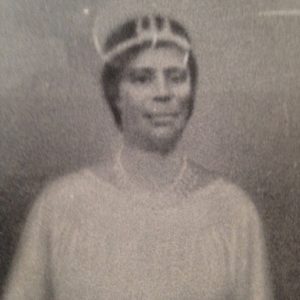
Mother Leafy Anderson, founder of the New Orleans Spiritual churches.
Photograph by Michael P. Smith, 1974, of original c. 1926 photograph.
[ AUTHOR'S NOTE ]
This isn't a cold case. It's a pattern. And you've seen it before.
The Reverse Great Migration
In the early 20th century, millions of Black Americans were making the Great Migration — moving north to escape Jim Crow, to find industrial work, to survive.
Anderson went south. Deliberately.
She founded the Eternal Life Christian Spiritualist Church in Chicago in 1913. Then in 1919 she left.
[ HISTORICAL CONTEXT ]
1919 is now called the Red Summer — named by NAACP activist James Weldon Johnson. White supremacist mobs tore through more than three dozen American cities.
In Chicago alone, five days of violence killed 23 Black residents and left over a thousand people homeless. It was the worst racial violence in the city's history.
Anderson moved to New Orleans that same year. She was leaving one of the most dangerous cities in America for Black people at that exact moment — heading toward the one city that had what she needed to build.
Her Vision
In New Orleans she built what the culture needed.
[ HER VISION ]
🙋🏾♀️ Believed women were as capable of spiritual leadership as anyone — ordained them, sent them out, and built a national network of congregations across Chicago, New Orleans, Detroit, Philadelphia and beyond that outlived her.
💰 Believed spiritual knowledge shouldn't be gatekept — charged a dollar a class (~$16 today) so working-class communities could access it directly.
🎷 Believed Black music belonged in Black worship — invited jazz bands in when other ministers were calling it the devil's music.
🎉 Believed that bringing jazz into church could change the culture — that decision helped collapse the boundary between sacred and street, and the second line tradition — still alive in New Orleans today — is part of what grew from that permission.
Anderson's spirit guide shows she understood how to use history to push an intersectional narrative.
She chose Black Hawk — a Sauk war leader who fought the U.S. government in 1832 and won several battles before being overwhelmed. One of the few Native American leaders to hand the United States a military defeat.
Anderson drew Black Hawk into the center of her church's theology and practice — he became a political and spiritual figure her community sought for guidance in matters of civil justice.
[ WHY THIS MATTERS ]
A Black woman chose as her central symbol the Indigenous leader who beat the U.S. government. Her church sought his guidance in matters of civil justice.
Black Hawk's spirit became so central that after Anderson's death, her successor Catherine Seals continued channeling him. After Seals died, Black Hawk passed from personal guide to community spirit — venerated across New Orleans Voodou, the Mardi Gras Indians, and rootwork traditions to this day.
The Atlanta Hawks are named after him. The franchise started as the Tri-Cities Blackhawks.
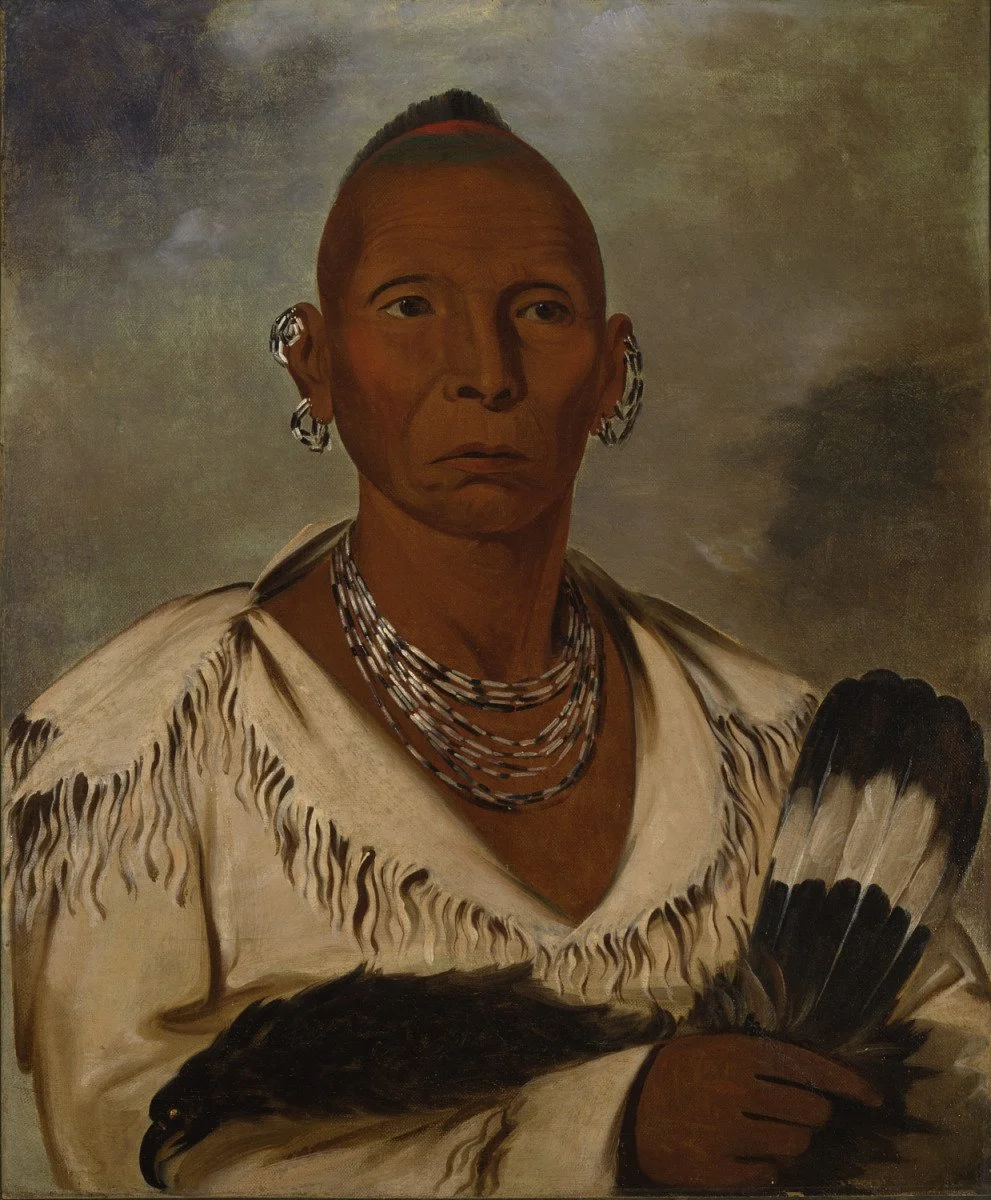
George Catlin, "Múk-a-tah-mish-o-káh-kaik, Black Hawk, Prominent Sac Chief," 1832.
Oil on canvas. Smithsonian American Art Museum. Public domain.
Then the Movement She Helped Build Kicked Her People Out
By the 1920s, Anderson's Spiritual Church Movement was spreading fast. Black Spiritualist congregations were opening in cities across America. The tradition she'd built from scratch was becoming a national force.
In 1922, the National Spiritualist Association of Churches expelled its Black members — not because of doctrine or practice, but because of segregation.
The response was the formation of the Colored Spiritualist Association of Churches.
[ YOU'VE SEEN THIS BEFORE ]
Decades earlier, Sojourner Truth used the same Spiritualist movement as the only platform where a Black woman could speak publicly at scale — then watched white feminism block Black women's access to the suffrage movement entirely. Different movement, same outcome.
[ A NOTE ON NAMING ]
The National Spiritualist Association was the white mainstream organization. Anderson's tradition was deliberately called "Spiritual" — not "Spiritualist." That distinction was intentional, a separate Black identity within the broader movement. The expulsion from the white Spiritualist mainstream only hardened it.
Anderson died in 1927, just five years after the expulsion.
The Erasure Isn't Accidental. It's Settler Colonialism.
Anderson built a national religious movement and doesn't have a verifiable hometown. Her obituary lists a Wisconsin town that never existed.
🏚️ James Williams owned a lead mine in Lafayette County, Wisconsin — the same region Black Hawk lived and fought. Williams died in 1903. The United States Geological Survey map of 1961 — 58 years later — still labeled his mine with a racial slur. He left no record of how he felt about it.
🔥 In 1921, Black Wall Street in Tulsa, Oklahoma was the wealthiest Black community in America. White residents and the National Guard burned it to the ground in two days. Over 35 blocks destroyed. As many as 300 people killed. Left out of Oklahoma history books for decades.
🍖 Walter "Unc" Johnson — Mr. Tendernism — built a viral brand that turned a struggling California coffee shop into a BBQ destination. His employer tried to trademark his phrase and cut him out. He got it back — but only because another member of the community stepped in first.
Black people build extraordinary things. The response is a pattern so consistent it has a name: who gets to own the story, who gets to profit from it, and who disappears from the record entirely.
[ THE THROUGH LINE ]
Settler colonialism has never been confused about who it documents and why. In Anderson's era, Black Americans were systematically underdocumented — birth certificates unrecorded, origins unverifiable, histories unpreserved. Not a bureaucratic oversight. A feature. When you control the record, you control who existed, who built what, and who gets credit.
The tools have changed. The project hasn't. Today the same communities face the inverse problem — not erasure from the record, but total capture in it. Facial recognition. DNA databases. Predictive policing algorithms. Surveillance infrastructure being written into policy through lobbying, given legal permanence, deployed disproportionately against Black and Indigenous communities.
Follow the money. Underdocumentation kept Black Americans outside legal protections. Overdocumentation feeds a surveillance economy built on incarceration and data extraction.
The Data Gap
[ THE DATA GAP ]
Sojourner Truth and Mother Leafy Anderson were foundational to American Spiritualism. Black women built this tradition. So why, when you look at Ghost Hunters, Ghost Adventures, haunted plantation tourism, and the broader paranormal industry — are there so few Black ghosts? Who gets to haunt, and who just disappears? The absence is the story.
[ ONE LAST THING ]
Anderson's last words were: "I am going away, and I am coming back, but you shall know that I am here." She spent her life building a practice around the belief that the dead communicate with the living. There is no documented account of anyone receiving her from beyond. The woman who founded a movement about talking to ghosts has no ghost story. Make of that what you will.
Sources & Further Reading
[ RED SUMMER ]
"Red Summer," Wikipedia
"Racial Violence and the Red Summer," National Archives, archives.gov
"Red Summer," National WWI Museum and Memorial, theworldwar.org
[ MOTHER LEAFY ANDERSON ]
Claudette A. Anderson, "Leafy Anderson and the Success of Black Spiritualism in New Orleans," Academia.edu
Jeff Harrington, "The Cult of Black Hawk," Chicago Tribune, December 6, 1998
"Leafy Anderson," Association of Independent Readers and Rootworkers, readersandrootworkers.org
"Mother Leafy Anderson: African American Medium," spiritualpathspiritualistchurch.org
"Spiritual Church Movement," Wikipedia; Encyclopedia.com
[ BLACK HAWK ]
"Black Hawk (Sauk leader)," Wikipedia
"Black Hawk," Association of Independent Readers and Rootworkers, readersandrootworkers.org
conjuringblackhawk.com
[ JAMES WILLIAMS / N-WORD JIM MINE ]
"African Americans in the Lead Mining District," Mining & Rollo Jamison Museums, mining.jamison.museum
[ MR. TENDERNISM ]
"Viral BBQ Star 'Unc' Wins Rights to 'Tenderism' After Trademark Dispute," Unheard Voices Magazine, March 2026
"Going Viral Doesn't Mean You Own It," Black Enterprise, 2026
[ DOLLAR CONVERSION ]
U.S. Bureau of Labor Statistics CPI data via in2013dollars.com
